Look into double-eyelid surgery and the vocabulary piles up fast.
In-line, out-line, semi-out-line, inner fold, outer fold, buried suture, incisional, partial incision, natural adhesion, epicanthoplasty, lateral canthoplasty, levator correction…
Look each one up and the definitions seem clear enough. In-line is natural, out-line is defined, semi-out-line sits between them.
And then you keep scrolling through photos and it gets more confusing.
"So which one actually suits my eyes?"
The honest answer is that other people's before-and-after photos can't tell you.
The person in the in-line photo and the person in the out-line photo have different eyes to begin with. Different size and length, different lid thickness, different face shape. Add different makeup and lighting and it stops being clear whether you're comparing crease lines or just comparing two people.
So this time, all three crease styles were applied to one person's face.
Same face, only the crease changed
Every image below starts from the same frontal photograph.

The face, the expression, the camera angle and the lighting all stay put. Only the crease changes.
All three also share the same iris-opening condition. How much of the iris shows is held identical — only the shape of the line differs.
Side by side like this, it gets much easier to see what each line actually does.
Switch between them and the difference shows
Tap through them one at a time. Watching the eye close and open shows how the line emerges far better than a single frozen frame does.
Below, each line is shown zoomed to the eye area. All three use identical crop coordinates, so anything that looks different is the line.
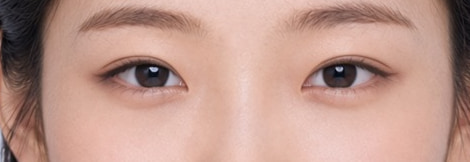
In-line
With an in-line crease, the line tucks inward as it approaches the inner corner.
The fold looks thin at the front and widens gradually toward the outside. Of the three, it reads as the softest and most natural.
Out-line
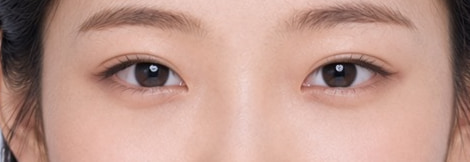
With an out-line crease, the line shows on the outside from the inner corner onward.
Because the front of the line stays visible, the eye looks larger and more open. Next to in-line, it is clearly the more striking, more defined option.
Semi-out-line
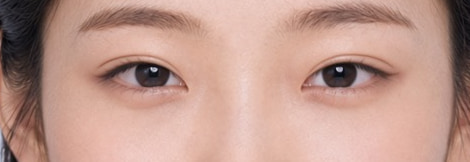
Semi-out-line is what the name says — roughly halfway between the two.
The line starts near the inner corner but never fully separates the way an out-line does. It's the shape people reach for when they want to keep things natural while still letting the crease show.
It's an expensive operation to decide on in your head
Once it's done you can't simply put it back if you don't like it, and revising it costs time and money again. It's a decision that takes a significant amount of money and a recovery period on top.
And yet plenty of people choose a line on the strength of "in-line is natural, out-line is striking" and nothing more.
They decide without ever having seen what it looks like on their own face.
Put plainly, that is not far from leaving the result to chance.
A line that looks good on someone else is no guarantee it suits you. Eye size and length, lid thickness, the shape of the inner corner, the overall impression of the face — all of it differs.
A simulation does not show you the actual surgical result. What it does let you check beforehand is which line is too much for you, which one changes too little, and roughly where it starts to feel natural.
Working out the direction first and then considering surgery is a good deal safer than deciding on surgery and then wondering whether it suits you.