Somewhere in a double-eyelid consultation, this often comes up:
"You'd want the eye-opening correction with it."
Here is why it gets added for some people and not others, and what that difference actually looks like in the result.
Levator correction is about lifting power, not about the line
Double-eyelid surgery creates a fold in the lid. Choosing between in-line and out-line is entirely a conversation about the shape of that fold.
Levator correction runs on a different axis. It deals with how strongly the eye opens.
When the muscle that lifts the upper lid is weak, even a fully opened eye shows only about half the iris. Looking upward takes more than the eye alone, so the forehead and brows come along with it. It's also why someone can be wearing an ordinary expression and still be told they look sleepy.
That is when the correction gets discussed alongside the crease — adding lifting power while the fold is being made.
What happens if only the crease is done
The fold appears. The lifting power doesn't change.
So you end up with a newly drawn fold on an eye that doesn't look as open as expected. Put bluntly, it's closer to a line added to the lid than to a bigger eye.
No amount of care in choosing the line shape changes this. The axis being chosen was never the one in question.
Same face, same line, correction on and off
The three below start from the same frontal photograph. All three carry the identical in-line crease — the only thing that changes is the correction.
Switch between them and watch how much of the iris shows.
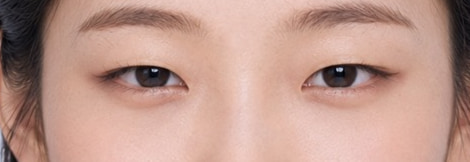
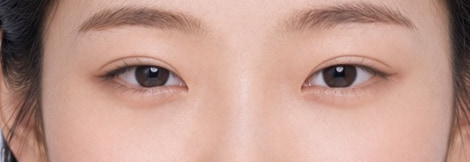
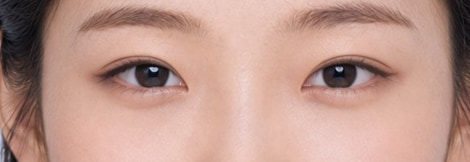
Judged on the line alone, the second and third are nearly the same. They read quite differently all the same, and what separates them is not the crease — it's how far the eye is open.
Crease only

Crease plus correction

So which one am I
A few things you can check in a mirror.
- With the eye open as wide as it goes, the top of the iris stays largely covered
- Looking up creases the forehead, or the brows rise with the gaze
- People read your ordinary expression as sleepy or tired
Matching a few of these does not mean the correction is called for. How weak the lifting actually is has to be measured in a consultation, how much to add differs from person to person, and more lift is not automatically better.
What a simulation can settle
A simulation does not show the actual surgical result, and it does not diagnose how weak the lift is.
What it can do is show you how different a fold-only result and an opened-eye result look on your face before anything is decided.
Hearing "you'd want the correction too" and having seen what that means are not the same starting point for a consultation.